Edit
Astana Think Tank Forum spotlights the role of middle powers in global affairs
Kazakhstan is serving as “an interesting illustration of the diplomatic balance which is needed in the global governance”, a U.S. scholar told the conference
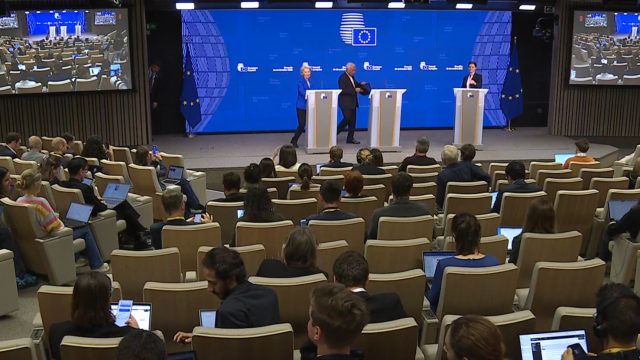
He spoke at the opening of the two-day Astana Think Tank Forum 2025 on Wednesday (15 October) in the Kazakh capital. The event, organized by the Kazakhstan Institute for Strategic Studies (KazISS), is held annually since 2024 with the ambition to provide a platform for honest, constructive policy dialogue between East and West in a polarised world.
Kazakhstan, a landlocked country in Central Asia with a population of 20 million, has been ranked for the first time as a “middle power” in 2024 by the German Institute for International and Security Affairs (SWP), on a par with G20 powers such as India, Japan, Germany, Turkey, Mexico, Canada, South Korea, Saudi Arabia or Brazil. Such countries can shape international events and are often characterized by their use of diplomacy, strong economies, and participation in multilateral institutions. Smaller nations in terms of territory and/or population included in the category of middle powers are Norway, the Netherlands, Poland and Belgium, although the latter is more often categorized as a “small” or “niche” middle power.
Ashikbayev focused on how to restore trust and adapt institutions to today’s shifting geopolitical landscape, reaffirming Kazakhstan’s global initiatives, including the proposal to establish an International Agency for Biological Security under the United Nations guidance to prevent pandemics and bioterrorism, as well as the opening of the UN Regional Center for Sustainable Development for Central Asia and Afghanistan in the former capital Almaty.
As an example, Ashikbayev mentioned the recent Gaza peace summit in Sharm-El-Sheikh, Egypt. According to him the summit was organized not only by the U.S., but also with the help of middle powers.
Kazakhstan, he said, played a role in the solution of the conflict between Armenia and Azerbaijan. Indeed, the foreign ministers of these countries held talks in Almaty in May. But the first step toward peace was made in Washington in August, Ashikbayev added.
Ashikbayev served as ambassador of his country to the U.S. until very recently. He was appointed as First Deputy Minister of Foreign Affairs upon his return, on 13 October.
At the United Nations General Assembly, the President of Kazakhstan Kassym-Jomart Tokayev said that the voices of responsible middle powers need to be seriously amplified in the Security Council. “Otherwise, the UN is doomed to forever mitigate consequences while root causes forever proliferate”, he said.
Magzum Mirzagaliyev, the Kazakh President’s advisor, told the forum the world today faces a profound “deficit of trust” between nations, within societies, and toward institutions. He warned that polarization has become a defining feature of international relations, undermining multilateral cooperation.
Sources told EUalive that Kazakhstan believes it qualifies for the category of middle power because of its size (the country covers about 64% of the EU’s area), its potential (the country is rich with critical raw materials and is politically stable) and ambition, which includes the proven capacity to contribute to strengthening regional and international security and stability. The role Kazakhstan can play is especially important due to the increasing confrontation and polarization on the world scene, they added.
However, Kazakhstan doesn’t see itself as a mediator in the conflict between Russia and Ukraine, a senior source from Astana said.
Indeed, Kazakhstan, a close historical ally of Russia through, has adopted a cautious, officially neutral stance on Russia’s full-scale invasion of Ukraine since February 2022, balancing its deep economic and security ties to Moscow with growing domestic anti-war sentiment and international pressures. This multi-vector foreign policy – long a hallmark of Kazakh diplomacy- allows Astana to avoid outright condemnation of Russia while signaling independence through symbolic and practical actions.
“Rather we are ready to provide ourselves as a platform for a meeting between parties who want to end the conflict. We are trying to resolve issues by their humanitarian side while not claiming that we have the capacity in arranging the final settlement,’ the source explained.
Astana has been mentioned multiple times as a possible venue for Ukraine-Russia peace talks, often due to Kazakhstan’s neutral diplomatic positioning between Moscow and Kyiv, though no actual negotiations have been held there for this conflict (unlike its role in the Astana Process for Syria).
Kazakhstan is serving as “an interesting illustration of the diplomatic balance which is needed in the global governance”, Joshua Lincoln, senior fellow at the U.S. Fletcher School of Law and Diplomacy at Tufts University told the forum.
“Kazakhstan is a member of the Shanghai Cooperation Organization (SCO), Collective Security Treaty Organization (CSTO), and the Eurasian Economic Union, and an associate member of BRICS Plus. At the same time, it continues to call for sovereign equality, the inviolability of borders, and the peaceful resolution of disputes. This kind of dual-track diplomacy we will need in the period ahead,’ Lincoln said.
Charles McLean, founder and managing director of the Borderless Consulting Group in the U.S., pointed out the need for effective leverage to address today’s crises.
“It’s a question of how you get the leverage to deal with big problems, such as the Gaza-level problems, the Ukraine-level problems. Sometimes we need external leverage, something powerful enough to make us sit together. We have experimented with everything – dynamite, aircraft, bombs, even nuclear weapons, but maybe what we now need is the leverage to bring us back to multilateralism,” he said.
Caption: From left to right: Sarangoo Radnaaragchaa, Yerzhan Ashikbayev, Saeed Khatibzadeh, Joshua Lincoln, Li Yongquan and Charles McLean. Photo credit: Astana International Forum @AstanaIntlForum on X.
Updated: October 20, 2025 - 15:13