Edit
Analysis: Vučić talks elections but keeps his cards close to his chest
Whatever the timing or format of the upcoming elections, the opposition remains unprepared to offer a credible alternative to the ruling regime
Serbian President Aleksandar Vučić continues to insist that elections will be held within the next five months, but this week he offered the clearest indication yet of what kind of elections he has in mind. At the same time, opposition parties are gradually shaping potential alliances, even as uncertainty surrounding the exact timing remains high.
Vučić’s strategic maneuvers
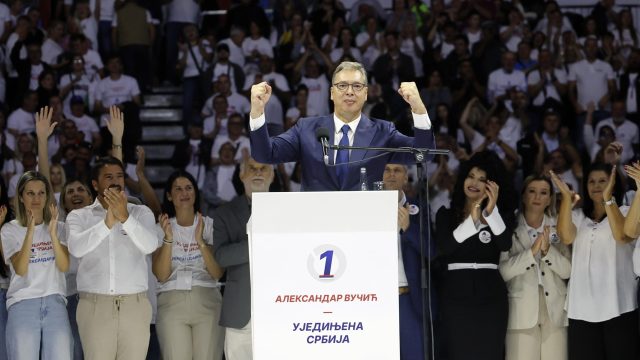
Last week, shortly after announcing that elections would take place between late September and mid-November, Vučić stated he would resign as President “in the coming months.” When asked whether this could happen within three to four months, he replied: “possibly even sooner.”
His comments align with widespread speculation that he may step down around St. Vitus Day (Vidovdan) on 28 June, coinciding with a major Serbian Progressive Party (SNS) rally in Belgrade. On 14 June, Vučić reiterated that elections are expected in “three to four months” and admitted he thinks “every day” about running for Prime Minister and selecting the ruling coalition’s presidential candidate.
For months, analysts have speculated that Vučić would resign as President during the summer, only to be elected Prime Minister by the current parliament, allowing him to delay full parliamentary elections until early 2028. This week, however, he publicly rejected that scenario for the first time.
“That case will not happen. I do not want to rule a single day if I do not have legitimacy, or be in any position if I do not deserve it,” Vučić declared. While such statements should be treated with caution given his well-known tactical style, the explicit rejection of becoming Prime Minister without fresh elections significantly increases the likelihood of early parliamentary and presidential polls being held on the same day this year.
By announcing his resignation, Vučić has also opened the question of the ruling coalition’s presidential candidate. With growing public dissatisfaction and a mobilized anti-regime bloc, the choice is delicate. Speculation centres on whether he will opt for a party loyalist or a non-partisan figure (such as Constitutional Court President Vladan Petrović or historian Čedomir Antić) to limit potential damage in case of defeat. Among party figures, National Assembly Speaker Ana Brnabić, Interior Minister and Socialist leader Ivica Dačić, and former President Tomislav Nikolić are frequently mentioned. Party leader Miloš Vučević and Oath Keepers leader Milica Đurđević Stamenković are considered less likely.
Pro-European opposition seeks unity
On the opposition side, pro-European parties and movements – including Dragan Đilas’ Freedom and Justice Party, Miroslav Aleksić’s People’s Movement of Serbia, Zdravko Ponos’ Serbia Centre, the Green-Left Front, Pavle Grbović’s Free Citizens Movement, and Aleksandar “Ćuta” Jovanović’s Ecological Uprising – have held regular meetings since early indications of possible early elections.
A broad joint list now appears unlikely. The Green-Left Front has instead thrown its support behind the student-led ticket, alongside the Democratic Party (Srđan Milivojević) and Get Going for Change (Savo Manojlović). Only Dragan Đilas and Zdravko Ponos have so far committed to forming a pro-European coalition under the slogan “Direction: Europe.” Pavle Grbović is reportedly close to joining, while Miroslav Aleksić and Aleksandar Jovanović are keeping their options open. Analysts warn that a split into two separate pro-European tickets could jeopardize crossing the 3% electoral threshold.
Deep divisions on the right
Right-wing opposition parties face even greater challenges. Miloš Jovanović’s New Democratic Party of Serbia (Novi DSS) pushes for a clear anti-Vučić “authentic right” bloc (NADA coalition), while Branimir Nestorović’s We – The Power of the People movement is widely seen as “controlled opposition” serving the regime. Nestorović has hinted at a presidential run, which many view as an attempt to fragment the anti-regime vote. Similar roles could be played by Vojislav Šešelj (Serbian Radical Party) and businessman Bogoljub Karić.
As the political landscape shifts, Vučić’s next moves – particularly the timing of his resignation and the choice of presidential candidate – will likely determine whether Serbia heads to the polls this autumn in what could become one of the most consequential election cycles in recent years.
Caption: A protester holds a wooden cross during a mass student-led anti-government rally in Belgrade, Serbia, 23 May 2026. Thousands gathered to ramp up pressure on the government and demand early parliamentary elections. The political movement originally erupted across the country following the November 2024 canopy collapse at the Novi Sad railway station that killed 16 people. EPA/ANDREJ CUKIC
Updated: June 18, 2026 - 06:03