Edit
Analysis: Unpacking Armenia’s political turmoil – Church, Russia, and Pashinyan’s power play
Are the PM's actions a strategic crackdown to secure power or a response to genuine threats?
Armenia’s recent wave of high-profile arrests, including clerics and a Russian-Armenian billionaire, signals a deepening conflict between Prime Minister Nikol Pashinyan and the Armenian Apostolic Church (AAC), intertwined with alleged Russian-backed coup plots and looming 2026 elections.
This analysis by European Pravda explores the roots of this turmoil, questioning whether Pashinyan’s actions are a strategic crackdown to secure power or a response to genuine threats, and examines the roles of the Church, Russia, and domestic politics in shaping Armenia’s future.
On 25 June Armenia’s political landscape erupted with the arrests of 14 individuals, including Archbishop Bagrat Galstanyan and other Armenian Apostolic Church (AAC) clerics, accused of plotting a “forcible seizure of power.”
These events, coupled with the detention of Russian-Armenian billionaire Samvel Karapetyan and Pashinyan’s public feud with Catholicos Karekin II, reveal a complex struggle involving domestic power dynamics, the AAC’s influence, and Russia’s shadow ahead of the June 2026 parliamentary elections.
The Church as a political flashpoint
The arrests stem from a broader conflict between Pashinyan and the AAC, a cornerstone of Armenian identity since 301 AD.
Tensions escalated in May 2025 when Pashinyan accused Catholicos Karekin II of breaking his celibacy vow and fathering a child, demanding his resignation – a move lacking legal authority under Armenia’s constitutional church-state separation.
Pashinyan’s provocative rhetoric, including a bizarre offer to prove his Christianity by showing the patriarch his penis as proof he is not circumcised, intensified the feud. The AAC, traditionally pro-Russian and tied to the pre-2018 regime, has become a hub for anti-Pashinyan sentiment, particularly after Armenia’s 2020 and 2023 defeats in Nagorno-Karabakh, which fuelled public anger over territorial concessions to Azerbaijan.
Archbishop Bagrat Galstanyan, leader of the Sacred Struggle movement, has channeled this discontent, leading protests in 2024 against border demarcations in Tavush. His arrest, alongside Archbishop Mikael Ajapahyan, on charges of planning terrorist acts and a coup, suggests Pashinyan views the Church as a political threat. Authorities allege Galstanyan recruited 1,000 former soldiers for 200 strike groups to disrupt Armenia on Independence Day, 21 September 2025, with audio recordings and weapons cited as evidence. Galstanyan’s lawyer dismissed the charges as “fiction,” and supporters claim Pashinyan is targeting dissenters to secure his Civil Contract party’s position.
Russian influence and Karapetyan’s arrest
The detention of Samvel Karapetyan, a Russian-Armenian tycoon and AAC benefactor, on 18, for allegedly calling for a government overthrow, adds a geopolitical layer. Karapetyan’s control of the Electric Networks of Armenia (ENA) gave him leverage to destabilize the country, prompting Pashinyan to nationalize the company.
Pashinyan’s spokesman hinted at Russian orchestration, calling it a “classic manual from the north,” while billboards supporting Karapetyan appeared in Moscow. Political analyst Mikael Zolyan argues that the arrests reflect Pashinyan’s concerns about Russian-backed efforts to counter Armenia’s Western pivot, especially after its withdrawal from the CSTO, the Moscow-led defence alliance, and his plans for EU rapprochement. Russia’s interest in replacing Pashinyan with a loyal figure aligns with its broader regional strategy, as seen in Georgia and Moldova.
Pashinyan’s pre-election strategy
With parliamentary elections set for 7 June 2026, Pashinyan’s actions may be a pre-emptive strike to weaken a fragmented but vocal opposition. Local elections in Gyumri and Parakar in March 2025 exposed Civil Contract’s declining support, failing to secure a majority despite taking first place. The AAC’s role as an opposition rallying point, amplified by clerics like Galstanyan, threatens Pashinyan’s grip, especially as polls show low approval ratings. The dismissal of National Security Service head Armen Abazyan on 18 June, reportedly for refusing to arrest Karapetyan, suggests Pashinyan is consolidating loyal security forces to act decisively.
However, the opposition’s weakness – lacking cohesive leadership and lower ratings than Civil Contract – complicates the narrative of a coup threat. Zolyan suggests Pashinyan’s crackdown may aim to demotivate opposition voters by neutralizing radical voices, a tactic echoing his 2020 Constitutional Court purge. Critics, including the Republican Party, accuse Pashinyan of authoritarianism, using law enforcement to silence dissent.
Foreign policy implications
The turmoil risks derailing Pashinyan’s foreign policy, particularly peace talks with Azerbaijan and Turkey. The AAC’s opposition to border concessions, voiced by Karekin II, aligns with nationalist sentiments, potentially undermining negotiations. Pashinyan’s Moscow visit on 9 May signalled a cautious re-engagement with Russia amid fears of a post-Ukraine war resource shift, but his EU aspirations remain a flashpoint. The alleged Russian-backed coup plot, if credible, underscores Moscow’s intent to keep Armenia in its orbit, while Pashinyan’s crackdown may alienate pro-Russian segments of society, deepening polarization.
A longer version of this analysis can be found here.
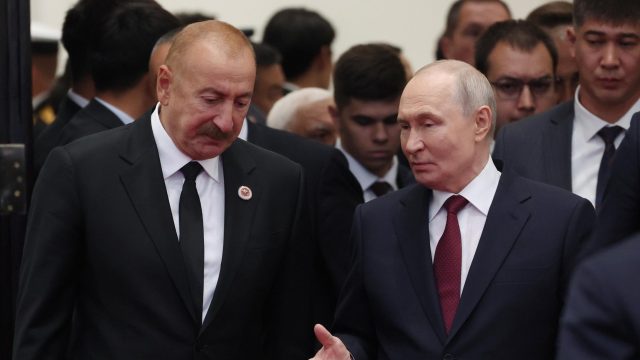
Caption: A handout photo made available by Photo Host Agency RIA Novosti shows Prime Minister of Armenia Nikol Pashinyan arriving for a gala concert held for heads of foreign delegations attending celebrations to mark Victory Day in Moscow, Russia, 08 May 2025. Russia will mark the 80th anniversary of the victory in World War II over Nazi Germany and its allies on 09 May Moscow time. EPA/ALEXANDR KRYAZHEV
Updated: June 30, 2025 - 05:52