Edit
EditAnalysis: In the Balkans, politics change through “explosions” of comet parties
From Athens to Sofia and Bucharest, the sudden rise of new political forces is a symptom of low trust, weak representation and institutional strain
In the Balkans, politics does not change only through elections; it also changes through sudden “explosions”. Parties that were until recently unknown or marginal can achieve abrupt surges, enter parliaments, reshuffle political balances and – quite often – squander their political capital just as quickly, either because of internal fractures or because of the wear and tear that comes with proximity to power.
The phenomenon of so-called “comet parties” is not merely an electoral curiosity. It is a diagnostic tool for how institutions function, how stable representation really is, and where social distrust towards established forces has accumulated.
Greece has served as a laboratory of party volatility in the post-crisis era. Economic adjustment, prolonged social pressure and shifting identities reconfigured the axes of representation. The participation of Popular Orthodox Rally in the Papademos government in 2011 showed how a party with an anti-system profile could, under conditions of institutional emergency, be rapidly absorbed into power management – at the cost of cohesion and political durability. The entry of DIMAR into government in 2012, followed by its withdrawal, highlighted the dilemma of “intermediate partners”: they can act as stabilising bridges, but often struggle when governability demands painful choices, discipline and organisational depth. The Independent Greeks embodied a heterogeneous protest alliance that reached co-government with SYRIZA, confirming that the real test for a comet party is not entry into the system, but the ability to convert denunciation into consistent institutional behaviour without self-cancellation.
In Turkey, comet dynamics also emerge as elite breakaways. The İYİ Party originated from a split in the nationalist camp and sought a kingmaker role in opposition configurations. At the same time, the parties founded by former senior figures of Justice and Development Party- DEVA Party of Ali Babacan and Future Party of Ahmet Davutoğlu – illustrate formations built on personal political capital, attempting institutional critique of the presidential model. The rise of Yeniden Refah Party under Fatih Erbakan shows that comets are not necessarily products of political modernity; they can also revive traditions with new timing and renewed communication strategies.
In Bulgaria, repeated elections and governmental deadlock have turned comets into a recurring feature of a fragmented field. There Is Such a People (ITN) rose as a powerful anti-system actor, while We Continue the Change capitalised on anti-corruption sentiment and then faced the challenge of translating anti-elite rhetoric into governance. The key conclusion is not that comets generate instability, but that they illuminate it: when institutional trust is low and party loyalties weak, electoral behaviour becomes volatile, and rupture-oriented actors overperform without necessarily possessing the tools to change the rules of the game.
In North Macedonia, the comet is not only a party but also a coalition. The emergence of VLEN as a governing partner after the 2024 elections reshaped the Albanian-speaking political space, underlining both the potential for governability and the importance of internal cohesion when political energy shifts from opposition to policy co-production. The presence of Levica confirms that new actors can influence public discourse even without executive power.
In Cyprus, the phenomenon has acquired a distinctly digital form. The election of influencer Fidias Panayiotou to the European Parliament in 2024 demonstrated how protest sentiment can channel votes towards unconventional candidates that bypass traditional party machinery. At the same time, the rise of ELAM shows that comets are not ideologically neutral and can serve as vehicles for radicalisation. The appearance of ALMA ahead of the 2026 parliamentary elections completes a picture of a society searching for new forms of representation.
In Romania, Alliance for the Union of Romanians (AUR) emerged as an anti-system nationalist force after 2019 and entered parliament in 2020, showing that some comets can evolve from surprise to stable pole if they acquire organisation and discipline. Similarly, in Bulgaria, Revival has steadily grown with an openly Eurosceptic and nationalist agenda, challenging foreign policy choices and sanctions against Russia. Here, comet politics gains a clear geopolitical dimension: when such actors become kingmakers or governing partners, the issue is not only internal stability but also external policy consistency within the EU and NATO.
This leads to the core question: are comet parties a sign of democratic renewal or a symptom of structural instability? They can be both – but through different mechanisms. Renewal occurs when new actors introduce agendas, refresh elites, enhance accountability and transform protest into coherent institutional participation. Instability dominates when electoral surges rest on personality, anger or communication speed without organisational backbone, producing fragile majorities and erratic governance.
Ultimately, comet parties are neither saviours nor threats in themselves. They are a thermometer. When they improve representation and accountability, they signal democratic adaptability. When they become a recurring pattern without restoring trust in the rules, they point to deeper structural fragility – a democracy rich in electoral motion but poor in institutional consolidation.
The original article in Greek can be read here.
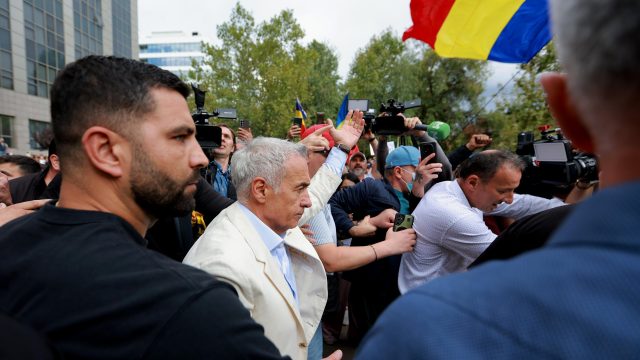
Caption: People wave Romanian flags and placards while shouting during a protest in downtown Bucharest, Romania, 15 January 2026. The protest was organized by the ultra-nationalist Conservative Action Party and joined by supporters of the Alliance for the Union of Romanians (AUR) against the government’s austerity measures and to mark National Culture Day, drawing participants from across the country. EPA/ROBERT GHEMENT
Updated: February 17, 2026 - 06:45