Edit
Analysis: If Vučić calls elections, it means he plans to stay in power longer
It appears that Serbia’s strongman wants both parliamentary and presidential elections to be held this year, on the same day – but he may change his mind
Although the constitution grants the president a largely ceremonial role and empowers the prime minister, Aleksandar Vučić has always disregarded the law and imposed himself as the ultimate decision-maker in the state, writes Dušan Reljić.
Dušan Reljić is an advisor for European affairs in Brussels and Berlin.
Serbia´s President Aleksandar Vučić faces the perspective of “cohabitation”: sharing power to a certain degree with a political opponent. His second term ends 31 May 2027. The only way for him to retain power is to switch to the position of prime minister. However, there is no candidate from within the regime who is certain to win the presidential elections. This means that, after being elected prime minister, he could be confronted with a new head of state who is backed by opposition groups.
Although the constitution grants the president a largely ceremonial role and empowers the prime minister, Vučić has always disregarded the law and imposed himself as the ultimate decision-maker in the state. The head of state is the only national official in Serbia who is elected directly by the people, which gives this person original political legitimacy. If this person was to use its legal and political influence, she or he would seriously limit Vučić’s ability to rule with his habitual complete disregard of the law. The prime minister is elected in the parliament and can lose his job if the political setting in the parliament changes. Therefore, Vučić can theoretically retain power as the future prime minster for an indefinite time, but practically he can lose it quickly as polls show that most of the voters are now against the incumbent government.
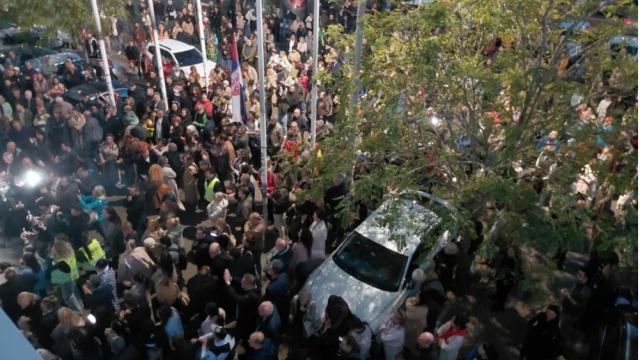
For more than two years, Serbia’s students and the urban middle classes are protesting almost without interruption corruption, the symbiosis between organised crime and state officials, the environmental decline and many other blatant deviations in the country. Workers and employees often take to the streets to demand an end to price rises and better working and living conditions. Nationalists accuse the President of betraying the nation by giving up on thwarting the Albanians from taking over Kosovo completely. This province is constitutionally part of Serbia, but independence was declared by its Albanian majority in 2008 in the aftermath of NATO’s attack on Serbia in 1999.
Presidential elections must be held by 1 May 2027. Next parliamentary elections must be held by 31 December 2027. Vučić has repeatedly said that voter will go to the polls before the end of 2026, but he did not make it clear whether he meant presidential or parliamentary polls. However, Vučić recently explicitly stated that he will not become prime minister without parliamentary elections. This could indicate that both elections will be held this year too, on the same day. Nonetheless, he is known to change his mind whenever he deems it opportune.
The public is speculating that Vučić is still trying to decide whether to choose a partisan or a non-partisan figure for his presidential candidate. Potential non-party figures could come from the academic community loyal to the authorities, such as university professor and Constitutional Court President Vladan Petrov and Čedomir Antić, a history professor at the Belgrade School of Philosophy. If they were to lose, the Progressive Party would suffer far less damage than if someone from the tightest circle of government were to lose.
The candidate mentioned most frequently from the ranks of his party is National Assembly Speaker Ana Brnabić. Socialist Party of Serbia leader and Interior Minister Ivica Dačić, Vučić`s long-time junior partner, has proposed himself for the post, but his health has seriously deteriorated. The candidacy of former Serbian president and Progressive party founder Tomislav Nikolić cannot be ruled out either, as he is said to be the most popular of all the Progressive party officials in opinion polls.
Among the opposition candidates, the name of the Rector of the University of Belgrade, architect Vladan Đokić, has been mentioned often. He has sided with the student movement and could enjoy their support. It is also possible that Dejan Bodiroga, a former international basketball star, could be a maverick candidate. He is an outspoken critic of the Serbian regime. If the opposition groups agree on a sindle candidate, the presidential elections will look like a plebiscite against or for the regime. As usual, the regime will prop up many fake independent candidates in an attempt to disperse the votes.
The Serbian society is highly divided, with poorer, less educated and non-urban voters providing the regime’s stronghold. The government controls most of the media landscape. Vučić appeared on the front pages of six daily newspapers close to the ruling authorities a staggering 1,172 times in 2025. Not even one of these articles portrayed him negatively. This figure doubled compared to 2023.
Serbia’s Vučić dominates pro-government tabloids: 1,172 front-page appearances in 2025, all positive
International and local monitors observed many breaches of the law in favour of the regime in the last several parliamentary and local elections, including violence against candidates and supporters of the opposition. As the upcoming votes are crucial for the survival of the regime, it is realistic to expect more irregularities and violence.
The crucial factor in both the presidential and parliamentary elections is whether the opposition groups, including the students preparing to vote in the parliamentary elections independently, can rally around one candidate and unite on one electoral platform.
There are many political parties and alliances in Serbia, most of which have few supporters and limited resources. The ruling Progressives (SNS) are the only exception. The voters have a problem in distinguishing among the opposition groups also because they tend to change their names from one election to the other. There is no single political group acting as the pivot of the opposition. Furthermore, the regime has always supported, or even directly established, fringe political groups with the intention of further splitting its opponents.
The President and his entourage constantly denigrate all opposition groups, the student movement, public intellectuals, and anyone else they see as potentially dangerous, using the vilest terms: traitors, paid foreign agents, criminals, and many others. The police, secret services and advisers from abroad (the UK and Israel and other countries) are targeting all opponents. The political arena in Serbia is an uneven playing field, with the state apparatus and its critics locked in a permanent battle.
However, the rise of the student movement since the end of 2025 pushed the President into the defence. Also, many affairs and incidents further tarnished his standing. Most recently, the head of the Belgrade police (who used to be the President’s adviser for combatting organised crime) was imprisoned on charges of covering up a murder. It happened in a prominent Belgrade restaurant following a dispute between the bosses of two criminal gangs whom he had brought together that evening.
Reacting to the rise of the student movement in Serbia, the EU and other western officials showed, although hesitantly, last and this year more leaning to criticise Vučić and regime for their obvious disregard of the rule of law. However, they avoided up to now an outright confrontation with him. The usual argument is that if the West were to tackle Serbia’s ruler openly, he would behave even worse and tilt completely towards Russia and China.
Furthermore, the Western media and, most likely, EU political leaders do not consider the Serbian opposition to be strong enough to remove the deeply entrenched government from power. Many are suspicious of the student movement because it rejects the recognition of the secession of Kosovo Albanians, labelling the students as nationalists.
At the same time, western European officials also notice how Serbia’s president is desperate to make a good impression on Trump’s administration. This is mostly not to their liking. Yet, in Serbia and in Albania, lucrative business deals in tourism and construction with Trump family members and people close to the US president did not yet materialise because of popular resistance against them.
If a semblance of regularity is retained in the forthcoming presidential and parliamentary elections in Serbia, the established procedure in the EU´s relations with Belgrade will be continued. If there are gross violations of basic electoral rules and violence against the opposition, the EU will give Serbia even lower priority in its EU accession process. The EU would also likely use stronger language in its condemnations of the Serbian government’s violations of human rights and democratic principles.
If Serbia’s leader was to break the energy ties with Russia and restrict trade and investment expansion with China, the EU would welcome this as a sign that Serbia is finally aligning itself with EU policies on common security and defence. However, this would not make the process of entering the EU any quicker.
Last not least, the wish to enter the EU is now not a driving force in the political vision of the Serbian population. Fewer than a third of Serbian citizens have a positive view of the EU; likewise, fewer than a third would vote for membership of the Union, while 40 per cent think that Serbia will never become a member, according to the results of the European Commission’s annual survey published mid-June 2026.
Regarding EU membership, the citizens of Serbia are most concerned about the exploitation of natural resources (43 per cent) to the detriment of the country, the brain drain (35 per cent) and that it would harm cooperation with Russia (33 per cent). When it comes to trust in individual countries and international institutions, 40 per cent trust the EU, 58 per cent the Russian Federation, and 56 per cent China.
The economic situation in Serbia is a mixed bag. But now, it does not look like money problems will turn into political trouble.
While the EU has mostly demanded a more cautious approach from Serbia in its economic and financial relations with China, it is calling for a clean break with Russia. But the EU’s requests have remained political without material sanctions against Serbia.
In contrast, the U.S. is taking a heavy-handed approach: Washington has forced Belgrade to get rid of Russia’s part in the ownership of Naftna Industrija Srbije (NIS), the country’s biggest oil company. Negotiations with Gazprom Neft regarding the sale of its stake in NIS are currently ending. If the U.S. approves, the Hungarian Energy Company MOL will take over the Russian part.
The US government proceeds in an alike manner against Chinese economic interests in Serbia. Mid-June 2026, the U.S. Customs and Border Protection (CBP) issued a Withhold Release Order (WRO) for copper and copper products manufactured by “Serbia Zijin Copper D.O.O.”. This decision takes effect immediately and CBP officials will henceforth detain shipments of copper products at all US entry points due to suspicion that the goods were produced using forced labour.
Similarly, in December 2025, the U.S. Customs and Border Protection issued a detention order for goods from the Linglong tire production factory in Zrenjanin, in the north of Serbia. CBP officials stated that they would detain shipments of these tyres at all U.S. ports due to evidence suggesting that forced labour had been used in their production.
At this time, there is no indication that the U.S. will alter its strategy regarding Chinese and Russian assets in Serbia.
Caption: Serbian President Aleksandar Vucic waves a Serbian flag during a rally of the ruling Serbian Progressive Party (SNS) in Belgrade, Serbia, 27 June 2026. Serbian President Vucic announced during the event that he will resign in the coming weeks. EPA/ANDREJ CUKIC
Updated: June 28, 2026 - 15:04