Edit
EditЕight countries block Serbia from opening Cluster 3, Vučić lashes at Croatia
The Serbian President said that Croatia "wants to see Serbia weak, poor and humiliated"
Serbian President Aleksandar Vučić said that “Croatia wants to see Serbia weak, poor and humiliated” after the news that EU countries didn’t find consensus on opening Cluster 3 in Serbia’s accession negotiations.
“Nothing new or unexpected – they like to see Serbia on its knees, a weak, poor and humiliated Serbia […] But as long as I am president, that will not be the case,” Vučić said.
Speaking on RTS in Belgrade, Vučić described the resistance at the EU ambassadors’ meeting in Brussels as expected. He said that “two or three countries”, as Serbia had anticipated, opposed the move to advancing the Competitiveness and Inclusive Growth cluster.
In fact, reports indicate that eight of the 27 EU member states blocked the cluster. The countries were the Netherlands, Belgium, Croatia, Bulgaria, Sweden, Finland, Estonia, and Lithuania. The main concerns raised were Serbia’s shortcomings in the rule of law and its failure to align with EU sanctions against Russia.
Tensions with Croatia
Vučić has frequently made accusations against Croatia. These include claims of political interference through support for opposition media during elections, allegations that Croatian authorities protect individuals accused of serious crimes and do not acknowledge the suffering of Serbs, comparisons of modern Croatia to the Ustasha regime of World War II, and criticism of Croatia’s military cooperation with countries such as Albania and Kosovo, which he has called a hostile act. The Croatian side has rejected these allegations as absurd and as domestic political rhetoric based on unproven claims.
Vučić also responded to statements by Croatian President Zoran Milanović at the NATO summit in Ankara. Milanović had warned that Serbia was strengthening its military capabilities and urged NATO to monitor the situation. Vučić acknowledged that Croatia has a strong army and is a NATO member, while confirming that Serbia is not part of the alliance. He said, “We respect Croatia, it has an extremely strong army, it is part of NATO, and we are not. We respect NATO, but we do not want to be part of NATO.” Vučić added that any aggression against Serbia would face much greater resistance than during the 1999 NATO bombing campaign.
Each of the eight countries blocking Cluster 3 has its own specific reasons for opposing the opening of the new cluster. While rule-of-law shortcomings and Serbia’s failure to align with EU sanctions on Russia featured prominently in the discussions, national concerns also played a key role. Bulgaria, for instance, has long expressed worries about the treatment of its minority in Serbia. Croatia remains focused on issues of mutual historical grievances, minority rights, and regional security dynamics, while countries such as the Netherlands, Sweden, Finland, and the Baltic states emphasize stricter adherence to democratic standards, media freedom, and full alignment with EU foreign policy. Belgium and Estonia, for their part, share broader worries about the pace of reforms and regional stability. These individual reservations, layered on top of the common EU positions, prevented consensus at the ambassadors’ meeting.
European Parliament adopts critical resolution
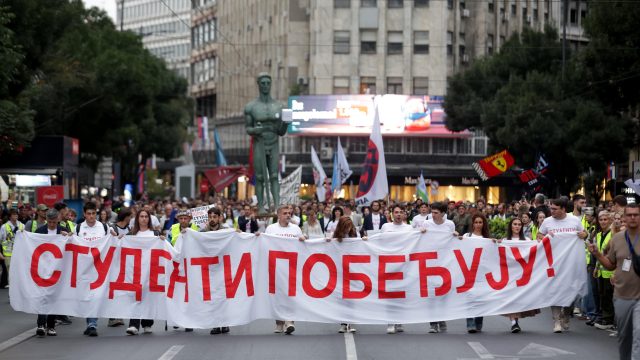
While Vučić spoke confidently at home, the European Parliament adopted a resolution with 468 votes in favor, 116 against, and 79 abstentions. The resolution expressed deep concern over Serbia’s path toward EU membership. It highlighted a significant slowdown in reforms, particularly regression in the rule of law. MEPs condemned repressive measures against peaceful protesters, activists, and journalists after the 15 March 2025 demonstrations in Belgrade, citing excessive police force, arbitrary arrests, and intimidation.
The European Parliament called for an urgent, impartial investigation into these incidents and raised the possibility of targeted sanctions against those responsible for human rights violations. The resolution stressed the need for Serbia to show a clear orientation toward the EU, including full compliance with EU foreign and security policy, especially sanctions on Russia. On Kosovo, it reiterated the importance of normalising relations and implementing the Brussels and Ohrid Agreements.
EP Rapporteur Tonino Picula described the vote as a strong message with broad support of around 70 percent, higher than the previous year. He pointed to limited or non-existent progress in nearly all areas, linked to political polarization, institutional weakening, and Serbia’s balancing between major powers. Picula questioned the European Commission’s recommendation to open Cluster 3, noting it was unclear what recent progress justified it given the Commission’s own critical assessment late last year. He highlighted media freedom and the Regulatory Body for Electronic Media (REM) as remaining critical unmet criteria.
Picula acknowledged Serbia’s complex position but urged alignment of foreign policy with the EU, reduction of ties that complicate relations with Russia and China, and measurable advances in democracy and the rule of law. He warned that without these steps the path to membership would remain blocked. He also commented on speculation about Vučić possibly returning to the role of prime minister, noting the EU does not interfere in internal matters but observing the president’s tendency to concentrate power.
European integration expert Vladimir Medjak told Beta agency that a country without rule of law, free media, and fair elections cannot successfully join the EU. He suggested that under the current leadership of Vučić and the Serbian Progressive Party, genuine progress appears unlikely. Medjak noted the resolution’s call to suspend Growth Plan funds to the Serbian government budget, while distinguishing these from IPA funds that directly benefit citizens. He said stronger international monitoring of upcoming elections is of utmost importance.
A EU diplomat told EUalive off the record that Brussels does not believe the current Serbian leadership’s commitment to the EU is genuine, but that Belgrade is merely mimicking it in order to secure access to EU funds.
Serbia’s EU bid in crisis: MEPs expose “false pro-European narrative”
Caption: Serbian President Aleksandar Vucic speaks during a decoration ceremony for fallen Serbian UN peacekeeper Senior Sergeant Milovan Jovanovic, in Belgrade, Serbia, 3 July 2026.EPA/ANDREJ CUKIC
Updated: July 9, 2026 - 11:48